How Many TLDs Does Wix Sell? The 2026 Extension Guide


Wix sells more than 400 top-level domains, covering classic extensions like .com, country codes like .co.uk and hundreds of newer industry extensions like .studio and .shop.
That number is a fraction of the extensions that exist. The internet's root zone holds well over a thousand top-level domains, but many are closed brand extensions or restricted country codes that no retail registrar can sell to the public.
This guide breaks down what that 400-plus catalog actually includes, how it compares with the full universe of extensions, what the most common ones cost and what to do if the extension you want isn't on the list.
Quick Answer: Wix offers 400+ domain extensions, including .com, .net, .org, popular new extensions like .online, .shop and .ai, and country codes such as .co.uk, .de, .ca and .com.au. Prices vary by extension, and annual website plans include a free domain for the first year.
What the Wix Domains TLD catalog includes
The quickest way to see the catalog is a domain name search on Wix Domains, which checks a name across popular extensions at once and links to the full TLD list. The catalog falls into three broad groups.
A top-level domain, or TLD, is the final segment of a domain name after the last dot. In example.com, the TLD is .com, and the part before it is the second-level domain you choose.
The three groups in the catalog are:
Legacy generic TLDs: the original open extensions, such as .com, .net, .org, .info and .biz
New generic TLDs: extensions launched since ICANN's 2012 expansion program, such as .online, .shop, .store, .studio, .tech and .xyz
Country-code TLDs: two-letter extensions tied to a country or territory, such as .co.uk, .de, .fr, .ca, .in and .com.au
The new generic group is by far the largest part of the list. It's where you'll find industry extensions like .coach, .yoga, .bar, .dental, professional options such as .attorney and .lawyer, and niche extensions like .pizza and .surf.
The nuance: "400+ extensions" counts some country-code variants separately. India alone appears as .in, .co.in, .net.in, .org.in, .firm.in, .gen.in and .ind.in, so the number of distinct countries covered is smaller than the raw extension count suggests.
How many TLDs exist in total in 2026
The full TLD universe is much bigger than any single registrar's catalog. According to the Domain Name Industry Brief (DNIB), published by Verisign, there were 1,265 generic TLDs and 316 country-code TLDs delegated in the root zone as of June 30, 2026.
The root zone is the top level of the domain name system, the master list of every extension the internet recognizes. IANA, the body that manages it, publishes the current list of delegated TLDs and updates it as extensions are added or retired.
Registrations are heavily concentrated in a few extensions. The DNIB counted 401.6 million registered domains at the end of Q2 2026, and .com alone accounted for 166.6 million of them.
The rest of the market breaks down like this, using the same DNIB report:
Country-code TLDs held 148.6 million registrations
New generic TLDs held 52.9 million registrations, up 34.0% year over year
Other legacy generic TLDs, excluding .com and .net, held 21.0 million
.net held 12.5 million
Why no registrar sells every TLD
No registrar sells every TLD, because a large share of the root zone isn't open for public registration at all. A catalog of 400-plus extensions covers most of what an ordinary business or individual can actually buy.
The extensions you won't find at a typical registrar fall into a few groups:
Brand TLDs: extensions owned by a single company for its own use, like .google, .apple or .bmw, which aren't sold to anyone else
Sponsored and restricted TLDs: extensions limited to a defined community, such as .gov for US government bodies, .edu for accredited institutions or .mil for the US military
Restricted country codes: ccTLDs whose registries require local citizenship, residency or a locally registered company
Internationalized TLDs: extensions written in non-Latin scripts, which many retail registrars don't offer
Extensions without a registry agreement: a registrar can only sell a TLD it's authorized to sell, and each registry sets its own terms
The brand TLD category is bigger than most people expect. Hundreds of the generic TLDs added since 2012 are .brand extensions held by corporations, which is a large part of why the root zone count and any registrar's catalog are so far apart.
Here's the subtlety: a registrar listing an extension doesn't mean anyone can register it. Some country codes in a catalog still carry eligibility rules, such as a Canadian presence for .ca or an Australian presence for .com.au, and the registry, not the registrar, decides who qualifies.
Learn more: the complete ccTLD list of country code domains
Popular Wix domain extensions and their prices
Wix publishes a starting price for each extension in its TLD list. The figures below were checked on the Wix site in October 2026 and show the first-year price, before any free-domain voucher.
Extension | Type | What it's used for | First-year price |
.com | Legacy gTLD | The default for most businesses | $7.90 |
.net | Legacy gTLD | Tech, networks and .com alternatives | $11.90 |
.org | Legacy gTLD | Nonprofits and communities | $6.90 |
.online | New gTLD | General-purpose web presence | $6.90 |
.shop | New gTLD | Online stores | $6.90 |
.store | New gTLD | Online stores | $36.00 |
.xyz | New gTLD | Creative and tech projects | $15.95 |
.ai | ccTLD (Anguilla) | AI companies and products | $160.00 |
.co.uk | ccTLD (United Kingdom) | UK businesses | $4.90 |
.de | ccTLD (Germany) | German sites and businesses | $14.95 |
.ca | ccTLD (Canada) | Canadian sites and businesses | $11.03 |
.tech | New gTLD | Tech companies and developers | $40.00 |
Renewal prices can differ from first-year prices, so they're worth checking before you commit. On Wix's domain search, .com is listed at $7.90 for the first year and renews at $21.35, while .net and .org both renew at $22.90.
A handful of extensions in the catalog are priced far higher than the rest. Extensions such as .car, .auto and .inc are listed at several thousand dollars a year, because their registries set high wholesale prices to keep them exclusive.
Wix domain extensions by industry
Industry extensions make up most of the catalog, and they're easiest to navigate by sector. The examples below come from the Wix TLD list, with first-year prices as listed in October 2026.
Extensions for creative and media businesses
Creative businesses have more extension choice than almost any other sector. Options in the catalog include:
.studio at $19.50, for design, photography and production studios
.design at $31.90, for design services and agencies
.art at $15.95, for artists, galleries and museums
.photography at $22.95, for photographers and photo studios
.media at $30.95, for content creators and publishers
.film at $97.90, for filmmakers and production companies
Extensions for health, fitness and wellness
Wellness extensions tend to be specific, which helps visitors understand a site at a glance. The catalog includes .fit at $10.00, .yoga at $10.00, .fitness at $25.00, .coach at $39.00, .clinic at $36.90 and .dental at $74.90.
The price spread in that group is wide. Extensions aimed at regulated professions, such as .dental, .doctor and .health, are often priced well above lifestyle extensions like .fit and .yoga.
Extensions for stores and commerce
Online stores can choose between several commerce extensions. .shop is listed at $6.90, .store at $36.00, .boutique at $15.90 and .market at $46.90, while .sale and .deals target promotional sites.
The DNIB ranked both .shop and .store among the ten largest generic TLDs in Q2 2026. That popularity makes them more familiar to shoppers than most industry extensions.
Extensions for professional services
Professional-services firms often want an extension that signals expertise. The catalog includes .consulting at $25.90, .agency at $22.95, .attorney at $65.90, .lawyer at $64.90, .accountant at $25.90 and .llc at $29.95.
The nuance: an industry extension works best as part of a clear name, not as a replacement for one. A name like smithlaw.attorney reads naturally, while a vague name on a specific extension can still confuse people about what the business does.
Restricted extensions in the Wix catalog
A few extensions in the catalog come with rules about who can register them. The registry for each one sets the rules, and the registrar collects the information the registry needs.
Common examples of eligibility rules include:
.ca, which generally requires a Canadian citizen, permanent resident or a business with a legal presence in Canada
.com.au, which requires an Australian presence, typically shown through an Australian Business Number
.de, which requires an administrative contact based in Germany
.fr, which generally requires a connection to the European Union or European Economic Area
Open country codes are the exception rather than the rule. Extensions like .co, .me and .tv place no residency limits on registrants, which is why they're widely used for branding far outside their home countries.
Does the TLD you choose affect SEO?
The TLD you choose has a limited direct effect on search rankings. Google has said publicly that it treats new generic TLDs like any other generic TLD, and that keywords in an extension don't give a site a ranking advantage.
Country-code TLDs are the main exception. Search engines use a ccTLD as a signal that a site is aimed at a particular country, which can help a local business appear in that country's results but may make it harder to rank elsewhere.
The indirect effects matter more than the direct ones. A familiar, trustworthy extension can earn more clicks from search results, and an extension that's easy to remember brings in more direct visits, both of which help a site over time.
How the free domain works on Wix
Wix includes a free domain for one year when you buy an annual website plan. The offer covers popular extensions like .com and .net and a range of others from the TLD list.
The free domain comes as a voucher, which needs to be redeemed within two months of buying the plan. After the first year, the domain renews at that extension's standard price.
Wix also includes a few features with every domain at no extra cost:
Free WHOIS privacy protection, which hides your personal contact details from the public registration database
A free SSL certificate, which encrypts traffic between your site and its visitors
DNSSEC support, which helps protect a domain from DNS spoofing
Registration terms of one to ten years, with auto-renewal available
WHOIS is the public database that records who registered a domain and how to contact them, and a free WHOIS lookup shows what's on record for any domain. Privacy protection replaces those details with proxy information so your name, address and phone number don't appear in public lookups.
The nuance: the free year is the easy part to compare, but renewals are what you'll pay every year after. When you're choosing between extensions, compare the renewal prices side by side, because two extensions that are both free in year one can differ by more than $15 a year afterward.
How to check if Wix sells a specific TLD
Checking whether a particular extension is available on Wix takes less than a minute. The process is:
Open the Wix domain search or the full TLD list
Type the full domain you want, including the extension, such as yourname.studio
Check whether the result shows a price and an add-to-cart option
If the extension doesn't appear, search the TLD list page for it directly
Read any eligibility notes before buying a country-code extension
If an extension shows as unavailable, it usually means the name is taken rather than that the extension isn't sold. The search results normally suggest the same name on other extensions, which helps when your first choice is gone.
What to do if Wix doesn't sell the TLD you want
An extension missing from a registrar's catalog doesn't stop you from using it with a website. You can register the domain at a registrar that sells it and connect it to your site.
Wix supports connecting a domain you bought elsewhere. There are two common ways to do it:
Pointing: you keep the domain at its current registrar and update its DNS records to point at your website
Name server connection: you change the domain's name servers so the website platform manages its DNS settings
DNS, the domain name system, is the internet's directory service. It translates a human-readable domain into the numeric address of the server that hosts the website.
Transferring the domain is a third option when the extension is supported. A domain transfer moves the registration itself to a new registrar, which keeps billing and settings in one place, though most generic TLDs can't be transferred within 60 days of registration or a previous transfer.
How to choose between 400+ domain extensions
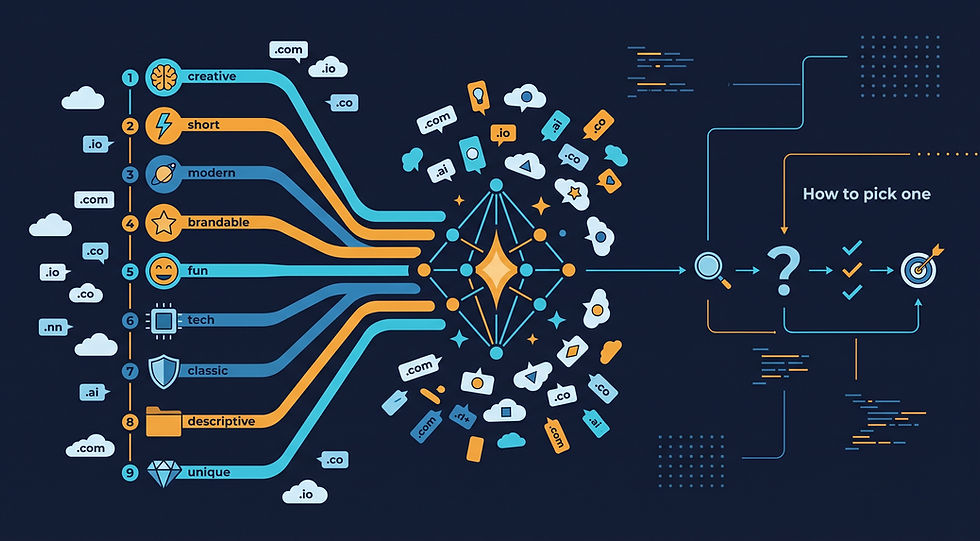
Having hundreds of extensions to choose from makes the decision harder, not easier. A short decision order narrows it quickly:
Check the .com first, because it's still the extension people type by default
If you only serve one country, consider that country's extension, such as .co.uk or .de
If an industry extension describes what you do, consider it, such as .studio for a design studio or .shop for a store
Compare renewal prices, not just first-year prices
Say the full domain out loud and make sure it's easy to understand
"Everyone reaches for .com out of habit, but familiarity and performance aren't the same thing. In our data, extensions that clearly signal what a business does are associated with stronger results. If your ideal .com is already registered, you can usually get your exact brand under a more creative extension that fits. Consider a yoga studio on .yoga, a bar on .bar or a company on .co." — Inbal Geva, Product Lead & GM, Wix Domains
The examples in that quote are all in the catalog, and they show the pattern that works best. An industry extension earns its place when it tells visitors something useful about the business, not when it's chosen only because it's cheap.
Some extensions carry baggage worth knowing about. .xyz is one of the largest new extensions by registration count, but the DNIB estimated its quarterly renewal rate at 17.5% in Q2 2026, well below the rates for established extensions, which suggests many registrations are speculative or short-lived.
Learn more: whether you can buy a domain name forever
Which domain extensions are most popular
Popularity matters because familiar extensions are easier for people to remember and trust. The DNIB's ranking of the ten largest TLDs by registrations at the end of Q2 2026 was:
.com
.cn
.de
.net
.org
.uk
.xyz
.ru
.top
.nl
Among generic TLDs specifically, the top ten were .com, .net, .org, .xyz, .top, .info, .shop, .online, .store and .vip. Together they made up 88.1% of all gTLD registrations, which shows how concentrated the market is despite the huge number of extensions available.
Several of those top extensions, including .com, .net, .org, .xyz, .info, .shop, .online and .store, appear in the Wix catalog. The large ccTLDs on the list, such as .de, .uk and .nl, are also available, so the extensions most people actually register are well covered.
Wix TLD catalog compared with the full root zone
The comparison below summarizes how a 400-plus catalog relates to the full set of delegated extensions:
Category | In the root zone | Typically sold to the public | In the Wix catalog |
Legacy gTLDs (.com, .net, .org, .info, .biz) | Yes | Yes | Yes |
Restricted gTLDs (.gov, .edu, .mil) | Yes | No | No |
New open gTLDs (.shop, .online, .studio) | Yes | Yes | Hundreds |
Brand TLDs (.google, .bmw) | Yes | No | No |
Open ccTLDs (.co, .me, .tv, .io) | Yes | Yes | Many |
Restricted ccTLDs (.ca, .com.au, .us) | Yes | With eligibility | Some, with eligibility rules |
The gap between the root zone count and any retail catalog is mostly made up of extensions nobody outside a specific organization can buy. For an ordinary business choosing an extension, the practical question isn't how many exist, it's whether the few that suit you are available and fairly priced.
How Wix compares with registrars that list more extensions
Some standalone registrars advertise larger catalogs than Wix. A bigger list matters only if it includes an extension you specifically need, such as an uncommon country code.
For most people, other factors carry more weight than the raw extension count:
Transparent pricing, including renewal rates and whether an ICANN fee is added at checkout
Whether privacy protection is included or sold as an extra
How easily the domain connects to a website and business email
The quality and hours of customer support
How simple the transfer process is if you ever want to move
ICANN, the Internet Corporation for Assigned Names and Numbers, coordinates the domain name system and charges a small fee on most generic TLD registrations. Some registrars add it at checkout, while Wix states that it doesn't add an extra ICANN charge.
Here's the subtlety: a long extension list can be a reason to choose a registrar, but it's rarely a reason to stay. If you register an unusual extension somewhere else, you can still connect it to a site built on another platform, so the catalog only has to cover the domain you're buying today.
Pricing patterns across the Wix TLD list
Prices across a 400-plus catalog follow a few recognizable patterns. Knowing them makes it easier to spot a good deal or an expensive trap.
The main patterns are:
Legacy extensions are the cheapest to start and mid-priced to renew. .com, .net and .org all start below $12 and renew a little above $20
Popular new extensions are often discounted in year one. .online and .shop start at $6.90, which makes them some of the cheapest extensions in the list
Professional and regulated sectors cost more. Extensions like .doctor, .attorney and .dental are priced well above lifestyle extensions
A few extensions are priced for exclusivity. .car, .auto, .security and .inc are listed in the thousands of dollars per year
Country codes vary by registry. .co.uk starts at $4.90, while .mx is listed at $45.95
Premium names inside a standard extension
A premium domain is a specific name that a registry prices above its extension's normal rate, usually because it's short or keyword-rich. A search for a common word on a new extension can return a price many times higher than the starting price in the TLD list.
Premium pricing applies to the name, not the extension as a whole. If a search result looks unexpectedly expensive, it's usually worth trying a longer or slightly different version of the name before giving up on the extension.
How long you can register a domain
Most extensions in the catalog can be registered for one to ten years at a time. A longer term locks in your ownership and removes the risk of a missed renewal, although it doesn't lock in the price, which the registry can still change.
Here's the subtlety: the cheapest year-one extension is often not the cheapest over five years. An extension that starts at $6.90 and renews at a much higher rate can cost more over its lifetime than a .com, so the five-year total is the fairest comparison.
How many TLDs does Wix sell FAQ
How many domain extensions does Wix offer?
Wix offers more than 400 domain extensions, including .com, .net, .org, hundreds of new generic TLDs and a range of country-code TLDs. The count includes regional variants, such as several second-level options under India's .in.
Does Wix sell .ai domains?
Wix sells .ai domains, listed at $160.00 for the first year in its TLD list in October 2026. .ai is the country-code TLD for Anguilla, and it's popular with artificial intelligence companies.
Does Wix sell country-code domains?
Wix sells many country-code domains, including .co.uk, .de, .fr, .ca, .com.au, .in, .it, .nl and .co. Some carry eligibility rules set by the country's registry, such as a local presence requirement.
Can I use a domain from another registrar with Wix?
You can use a domain registered elsewhere with a Wix site by connecting it through DNS records or name servers, or by transferring it if the extension is supported. The domain doesn't need to be bought from Wix to work with a Wix website.
What is a generic top-level domain (gTLD)?
A generic top-level domain is an extension that isn't tied to a country, such as .com, .org, .shop or .online. Most gTLDs are open to anyone, while a few, like .gov and .edu, are restricted to specific organizations.
What is a country-code top-level domain (ccTLD)?
A country-code top-level domain is a two-letter extension assigned to a country or territory, such as .uk for the United Kingdom or .de for Germany. Each ccTLD is run by its own registry, which sets its own rules and prices.
Wix covers the extensions most people actually register
Wix sells more than 400 TLDs, which covers the extensions that account for the bulk of real-world registrations, from .com and .org to popular new extensions and the largest country codes. The 1,500-plus extensions in the root zone include hundreds that no retail registrar can sell.
Choose the extension that fits your audience, compare the renewal price and check that the full domain is easy to say. When you've found the right one, you can buy a domain with Wix and connect it to your website, privacy protection and SSL in one place.


Comments